
NAVIGATING CHALLENGES IN LARGE OPENINGS FIRESTOP APPLICATIONS
Having challenges choosing fire protection for large openings? Know how to firestop large openings effectively!
Having challenges choosing fire protection for large openings? Know how to firestop large openings effectively!

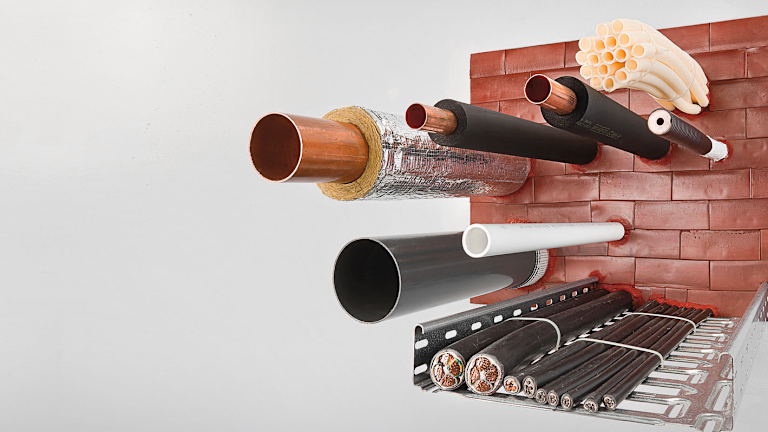
Large openings in construction refer to significant voids or cut-outs in a building's structure designed to accommodate multiple services and utilities. These openings are essential for the passage of mechanical, electrical, and plumbing systems, which are critical for the functionality of buildings. Consequently, large openings are designed to accommodate future services with flexibility. Large openings are typically found in walls and floors in all types of buildings. Providing proper passive fire protection for such openings is important to help retain the integrity of fire compartments as well as overall building safety.
Challenges in providing passive fire protection for large openings
There are some typical constraints that applies to large openings.
First, large openings often contain mixed trade services (mechanical, electrical, HVAC). As a result, large openings require firestop systems that are tested to cover the wide range of types of services passing through.
Second, designers need to make large openings as small as possible to save space in the building. Therefore, it is common to find many services passing through the same opening with minimal distance between them. This can limit the options when it comes to standard firestop solutions and often requires further effort and time during the construction phase.
Third, building movement—caused by thermal expansion, structural settling, or slab deflection due to weight—can transfer stress to service penetrations. If the firestop system cannot accommodate this movement, it may become damaged over time, compromising its effectiveness throughout the building’s service life. To ensure long-term performance, it is essential to select a tested, high-performing firestop solution that can accommodate expected building movements. Additionally, larger openings tend to reduce the stability of firestopping systems, making proper product selection even more critical.
How to firestop large openings effectively
To address the challenges of passive fire protection, it is crucial to consider it early in the design phase of a project. Designing individual service penetrations for each service element (e.g., single pipes, single cable bundles) simplifies the selection and installation of firestopping solutions. However, this is not always possible, and large openings are often designed as common practice.
Some strategies to reduce the challenges of firestopping large openings
Segregating electrical, mechanical, and ventilation service penetrations to reduce complexity.
Minimizing movement in the penetrations by ensuring services are properly supported within 300 mm of the penetration (ceiling, floor, wall). Hilti modular support systems provide excellent stability, even under fire conditions.
Utilizing high performing solutions like Hilti CFS-COS Firestop Composite Sheet to accommodate building movement, managing multiple mixed penetrations, and dealing with minimal spacing between services.
Hilti CFS-COS Firestop Composite Sheet is designed to seal large openings (up to 1200x500mm) with fire and temperature resistance up to 60 minutes (FT 60) and movement capabilities up to 25mm. It serves as an alternative to more traditional solutions like coated boards. Made from a highly compressible foam material, this seal makes installation, maintenance, and retrofitting easy tasks.
Requesting engineering judgements when there is no tested solution available on the jobsite for certain scenarios. Hilti’s technical experts offer advice and engineering solutions when needed.
Hilti’s commitment to sustainability
The Hilti CFS-COS Firestop Composite Sheet is designed for excellent fire protection and movement capabilities while meeting high sustainability standards. It is LEEDv4.1 compliant for VOC emission measurement, ensuring customers for their green building objectives and requirements. The certifications and compliances highlight Hilti’s commitment to sustainability and environmental responsibility. By integrating sustainability into its core business strategy, Hilti aims to contribute to a more sustainable construction industry and a better future for all.
Conclusion
Large openings in construction present significant firestopping challenges due to the complexity of accommodating multiple services. Hilti offers higher-performing solutions, which can seal large openings, provide fire resistance, and accommodate movement. Hilti CFS-COS Firestop Composite Sheet allows for simpler and faster installations while bringing peace of mind through movement accommodation.
References